
Latest postings
-
May 26, 2026
25 years celebrating the American roadside
Announcements
A distinct pleasure to join a group of fans like this.
We can share info.
We can do this in good cheer.
Keep up the good work.
-Mario Monti (1930-2016), May 26, 2001
On May 26, 2001, this was the first message published in a new Yahoo Group. Twenty-five years later, that has evolved into a Facebook page with over 1,300 followers. Today’s Facebook page remains true to the concept of that original Yahoo Group – a means to share news and information about diners and roadside attractions.
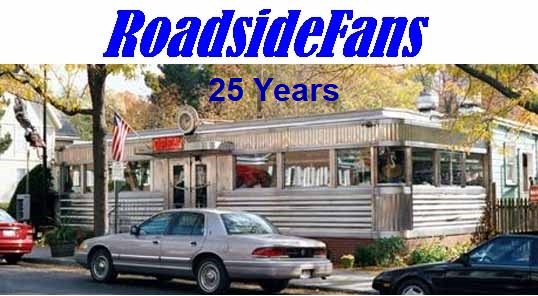
If you are young, 25 years seems like a long time; if you are old, not very long at all. Still, 25 years is long enough for significant changes to take place.
25 years ago, Internet access by the general public was still relatively new, and many accessed the Internet by dial-up modem. Film photography was still common. Not everyone had a cell phone, and those who did used them only for telephone calls. With social media still in the future, individuals with a common interest who could access the Internet often connected through message boards and e-mail.
And people got their diner news from Roadside Magazine, started in 1990 by Randy Garbin.
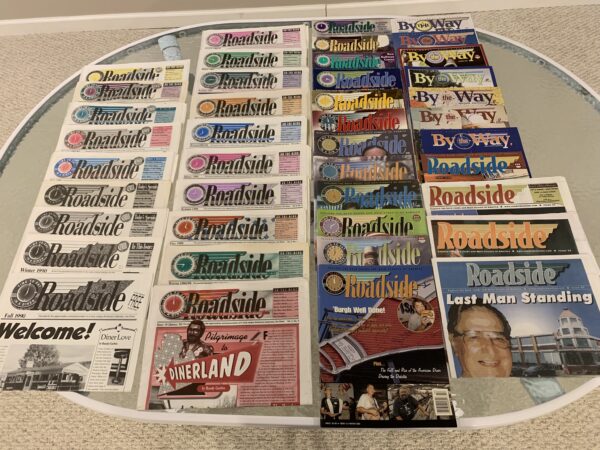
Roadside Magazine, published between 1990 and 2007, invited us to explore the back roads and Main Streets of America. The magazine shut down in 2001, reappeared under an alternate name By the Way, and regained the rights to its original name before ending for good in 2007.
The story of RoadsideFans begins where Roadside Magazine ended in 2001, after a new owner shut the magazine down after producing one glossy color issue (bottom of third column.) Stunned readers, who had come to depend on the magazine and its web site for roadside news updates, continued to post messages into a Yahoo e-mail group abandoned by the magazine.
I floated the suggestion that we start a new e-mail group that could share information about diners and other roadside places, much as Roadside Magazine had done. Soon, somebody posted, “Great idea, Glenn! Can you run it?” I have lost track of who that person was, but that was the spark that ignited RoadsideFans.
Several friends and e-mail acquaintances quickly joined RoadsideFans. Besides Mario Monti, Susan Levinson, Michael Engle, Kathy Stribley, Gregg Anderson, and Larry Cultrera were around in the early days of the group (and several are still around today.) Eventually the group would pass 1000 members.

Yahoo Groups logo from the time RoadsideFans was founded
After founding the e-mail group, I learned that the URL RoadsideFans.com was available, so I thought it would be a good idea to purchase it (and prevent anyone else from doing so.) For one thing, it was easier to tell people “RoadsideFans.com” to find the group instead of the long URL Yahoo provided. The first web site went live with the help of our son, Ray Milstrey, who was then a teenager with a growing interest in web site development. (He decided to make a career of it and is employed in the field today.)
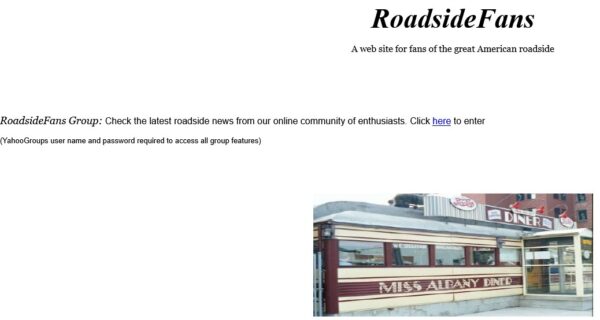
The first RoadsideFans web site had a link to the RoadsideFans group and little else.
In the coming months I would add more content to that original sparse web site. When I attended a diner tour in Queens, NY hosted by Mario Monti on September 29, 2001 (barely a month after 9/11) I was determined to post photos of the event, even though I did not own a digital camera or scanner at the time. My photos were taken with a single use film camera, the film was processed with the option of online digital copies, and I was able to put up a web page within a week or so after the event, which I thought was pretty good. If an event like this were held today, undoubtedly several attendees would be using their phone to post pictures to social media while the event was happening.
I would add information to the web site that could not easily be found elsewhere on the Internet, such as a key to diner manufacturers, which later expanded into a series of Diner FAQs.
Some of my pages still come up high in search results. For example, do a Google search on “diner serial number” and you get this:
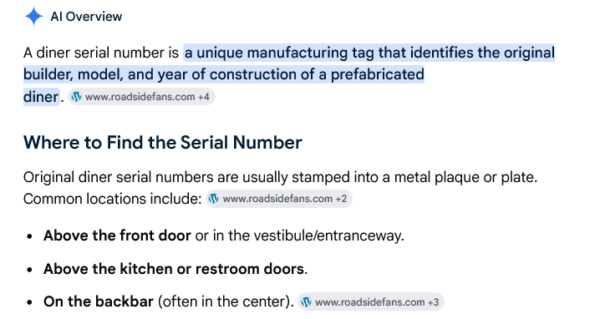
Google AI mines information I had posted years earlier.
I always had a fascination with Howard Johnson’s Restaurants, having watched those sparkling restaurants I visited as a child go into a long, slow decline. In 2002, I couldn’t find a page I liked about Howard Johnson’s, so I decided to write one myself. By this time I owned a scanner, allowing me to scan some film photos from a few years earlier. I even added a 1981 article about Lake George franchise owner Carl DeSantis, which was scanned and transcribed using optical character recognition.
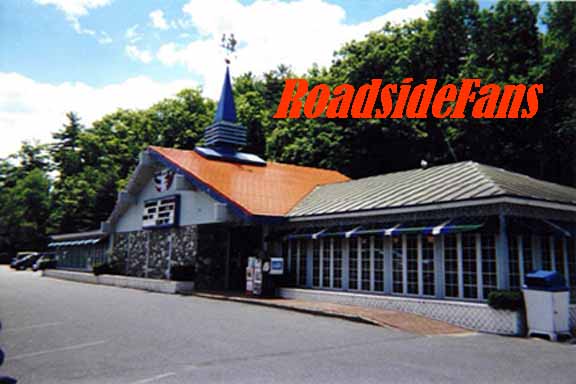
In 2002 the RoadsideFans web site added a Howard Johnson’s page that attracted more attention than I expected.
Years after I posted the Howard Johnson’s page I was surprised to see it referenced in the end notes to the book Ten Restaurants That Changed America by Paul Freedman, published in 2016. Then in 2018 I received an email from Bob Greene, who was working on an op-ed piece about Howard Johnson’s. The finished article, which includes a couple of quotes from me, was published in the Wall Street Journal on September 27, 2018.
I joined Facebook in 2010, after many of my friends and RoadsideFans Group members already had. At the same time I established a Facebook page for RoadsideFans. In the beginning, the RoadsideFans Facebook page served the same purpose as the RoadsideFans web site did originally – provide a handy link to help people find the Yahoo Group. It wouldn’t be very long before that would change, however. I found it much easier to post links and photos into Facebook, where most of the active RoadsideFans saw them instantly. Activity increased in RoadsideFans on Facebook, while in the Yahoo Group it was way, way down.
I tried to hang on, posting occasional updates to keep people in the Yahoo Group informed, but the trend was clear. Over time, I could only identify two Yahoo Group regulars who were not also on Facebook. Ultimately, Yahoo Groups would shut down on December 15, 2020, at which point the original RoadsideFans platform was gone.
Meanwhile, the RoadsideFans web site underwent a major redesign at the end of 2011, a Christmas gift from our son Ray who had launched the original web site years earlier. The WordPress blog with a fresh look offered opportunities for expansion which mostly went unrealized. I always planned to work on it more “when I retire” – and never did. Any time I had fresh news or trip photos it was easier to post them into Facebook and leave it at that.
Because of that, I have come to a decision. Going forward, RoadsideFans will exist only on Facebook and RoadsideFans.com, the web site you are now reading, will go dark when the term on my domain name expires in June 2026. It was not an easy decision to make, but I cannot justify the expense of keeping it going when the web site is due for another major upgrade, one I cannot handle myself and don’t want to ask Ray to do. (He’s busy enough with his career and being the best girl Dad ever.)
Among the changes that happen in 25 years, a sad one is the people you lose along the way. Among those important to RoadsideFans, and me personally, are Mario and Lucille Monti, Linda Gottwald, John Shoaf, Wally Day, and Ron Dylewski. I never got to meet the last two in person, but the spirit of fellow road warriors continues to lift me.
Social media is routinely criticized as a societal ill, but I keep thinking of all the good friends I have made in the last quarter-century that I never would have met if not for the Internet. This includes people living a mere 15 minutes away, as Michael Engle did before I moved. And when RoadsideFans have the chance to meet in person, a good time is guaranteed, even if it’s two or more hours of driving to get there.
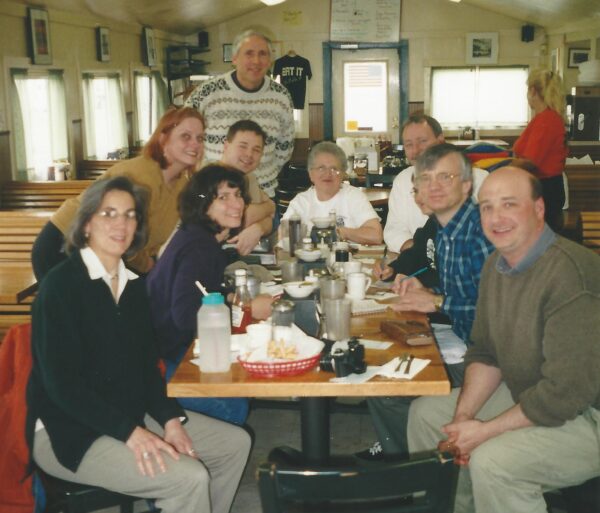
Glenn (standing) with the group at the first RoadsideFans Get-Together held at the original Stella’s Diner in Syracuse, NY, May 18, 2002. (Photo: Susan Levinson)
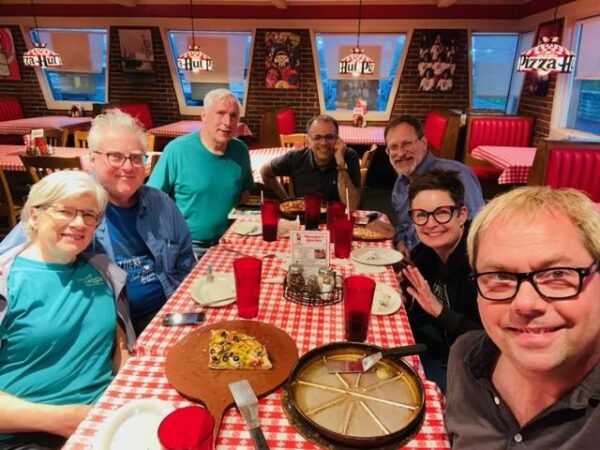
Nearly 21 years later, Glenn (third from left) attended a Pizza Hut meet-up in Tunkhannock, PA, April 22, 2023, organized by Rolando Pujol and Beth Lennon. (Photo: Cliff Hillis)
I’m hoping some of us might have the chance to meet, or meet again, in the not too distant future. Until then, remember I’m on Facebook every day.
Glenn Wells
RoadsideFan # 5501
May 26, 2026
-
October 16, 2021
Which way is your Pegasus leaping?
Roadside
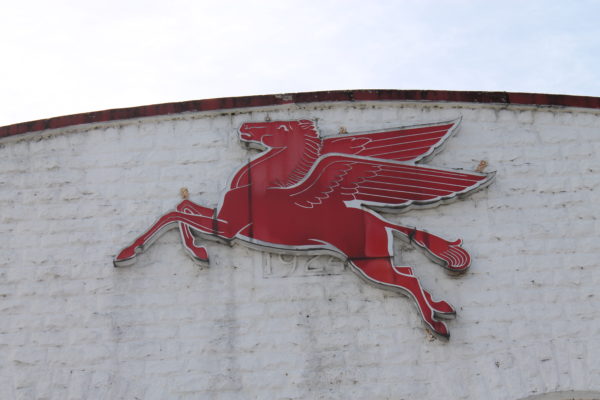
The red Pegasus has been the logo of Mobil, and before that Mobilgas and SOCONY, going back to 1931. The company itself is even older, tracing its origins to the Vacuum Oil Company of Rochester, NY, founded in 1866. Like so many oil companies of the early petroleum era, Vacuum Oil found its way into the Standard Oil empire of John D. Rockefeller. After the Standard Oil Trust was broken up in 1911, Vacuum Oil became independent again and the New York regional interests of Standard Oil became SOCONY – the Standard Oil Company of New York.
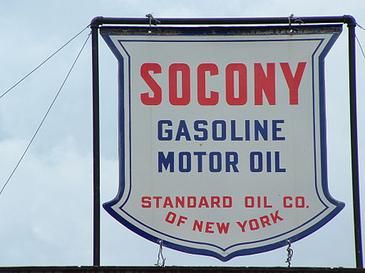
Then, in 1931, SOCONY and Vacuum Oil merged back together, after the government gave up trying to prevent it. The Socony Vacuum Oil Company adopted the red Pegasus as its trademark that year. The image of a flying horse was a powerful one in an era when horses were still remembered as a primary form of transportation, and gasoline engines were so powerful by comparison it almost seemed as though a horse could fly.
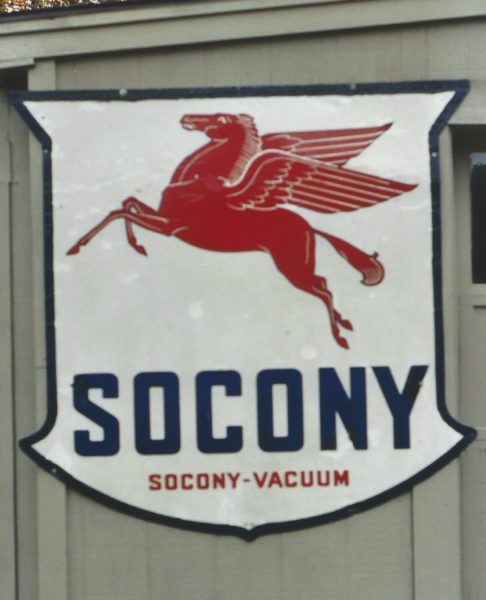
The name SOCONY would prove problematic for a company distributing its products nationally, however. As part of the 1911 Standard Oil breakup, use of the name Standard Oil – or any variation thereof – could be challenged by other Standard Oils in their home territory. This is precisely why Midwest Standard stations (Standard Oil of Indiana) were known as Amoco in the East, and why Esso – phonetically S. O. for Standard Oil – would eventually rename itself Exxon.
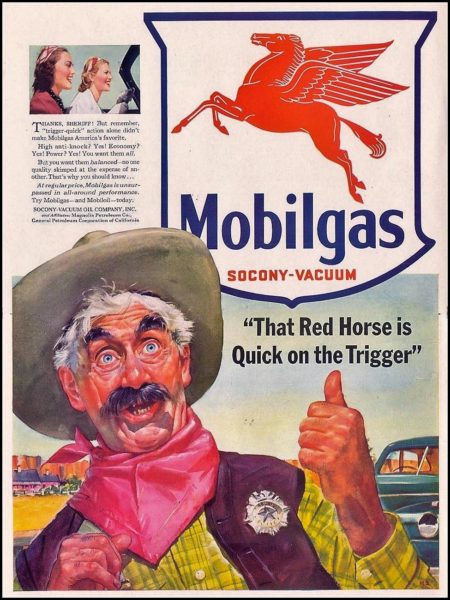
For Socony Vacuum (which also included regional companies Magnolia Petroleum in Texas and General Petroleum in California), the answer came in their brand names, Mobilgas and Mobiloil. Mobilgas – still paired with the red Pegasus – became the dominant name on the sign, with a smaller “Socony – Vacuum” underneath.
The corporate name and image would continue to evolve, becoming Socony Mobil Oil Company in 1956, with a new station sign that would have an especially short lifespan – only 10 years.
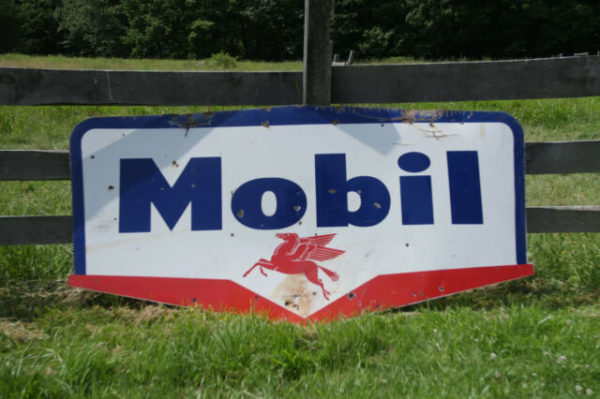
Then, in 1966, Mobil Oil Company celebrated its centennial, dated from the founding of Vacuum Oil in 1866, even though neither Socony nor Vacuum were part of the newly streamlined company name. It was time for a brand refresh:
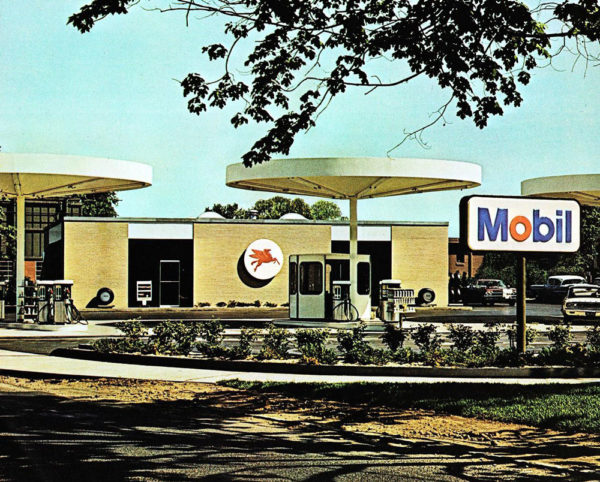
Chermayeff & Geismar.
Architect and industrial designer Eliot Noyes led a near total redesign of Mobil station imagery. The new gasoline pumps were sleek cylindrical affairs with circular lighted canopies overhead. The new station sign featured a red o in Mobil, a now familiar trademark for 50-plus years.
One trademark was carried over nearly intact – the red Pegasus. However, after 35 years of leaping to the left, the image was mirrored so it is now leaping to the right.
Why was this done? I heard one report that the Pegasus was now leaping into the future.
-
January 1, 2019
2018 in review: “Everything ends”
Roadside
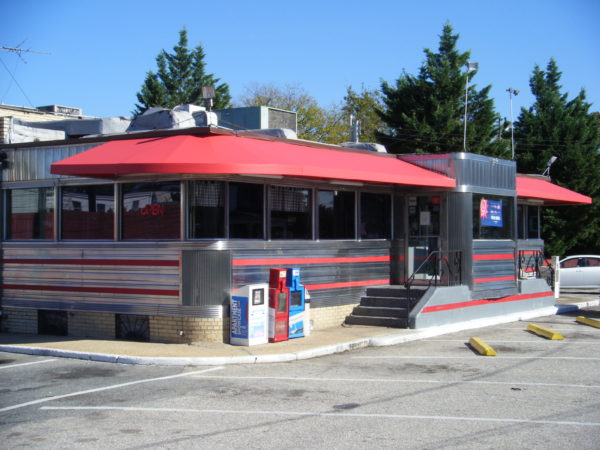
Tastee Diner, Laurel, Maryland. 2014 photo by Glenn Wells
On November 10, 2018, Spencer Stewart broke the news to the diner community that big changes were in store for the Tastee Diner in Laurel, Maryland. This rare Comac diner, one of only two operating, would be gutted, covered with a new facade, and converted to a medical marijuana dispensary. The bad news spread throughout the diner community, and a “Save the diner” movement was not far behind. Supporters of the diner were granted a major victory December 11 when the Laurel Planning Commission voted unanimously against granting the permit the dispensary would need.
The Washington Post reported, ” After the vote, supporters went to the diner for celebratory beers and grilled cheese sandwiches. There were high-fives, hugs and smiles. ”
But that same article contained another ominous quote, one that casts doubt on the diner’s future. Gene Wilkes, who has owned the diner since the 1970s and operates two other Tastee Diners in Bethesda and Silver Spring, indicated it was time to cut back and the Laurel diner might not have a future.
“I’m 75,” he said. “Everything ends.”
Everything ends. A simple truth of life, if not always a happy one.
I then looked back over all the roadside news from the past year posted on the RoadsideFans Facebook page and noticed a large number of endings for the year:
The Ben Franklin variety store in Middlebury, VT closed last summer. Once a staple of every downtown, the classic five and dime can now only be found in isolated, independently run stores, such as Sine’s 5 & 10 in Quakertown, PA or the Northville 5 & 10 in Northville, NY.
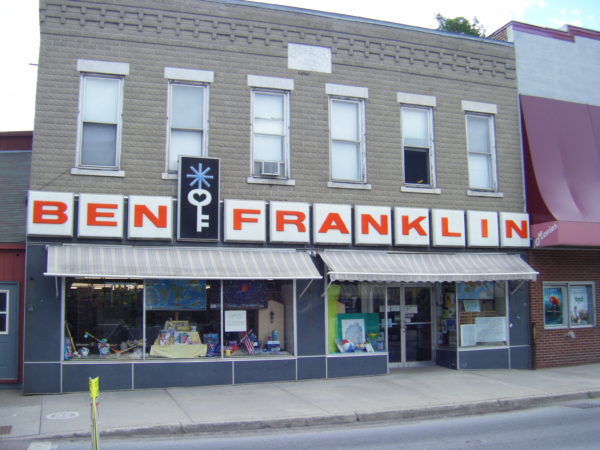
Ben Franklin, Middlebury, Vermont 2012 photo by Glenn Wells
Lombardo’s Restaurant in Albany, NY, after operating nearly a century, served its last Italian dinner New Year’s Eve. Its vintage multi-story neon sign is certain to attract the notice of collectors, but the interior, as Albany resident and longtime RoadsideFan Eric Stott notes, is “a flawless piece from the tin ceiling with deco light fixtures, down to the murals and booths, to the tiled floor. The stained glass beer signs in the window must be worth a small fortune. The whole space should be in the state museum as a prime example of an early 20th Century Italian restaurant. A New York City decorator would pay a fortune to recreate the ambience.”
O’s Eatery along the Taconic Parkway in Chatham, NY was destroyed by fire December 8. This was a 1963 Fodero, the third of the four Chief Taghkanic diners installed along the Parkway by Burt Coons. Its Space Age styling with Western style wagon wheel light fixtures overhead represented an era in diner style never to be seen again.
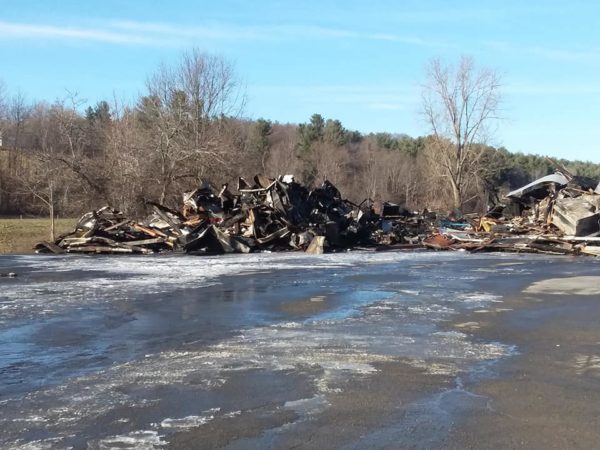
All that remains of O’s Eatery. Photo by Bob Butler
Fat Boy Drive-In in Brunswick, Maine is for sale. Just down the road from the vintage Ernie’s Drive-In (now Cameron’s Lobster House), two operating carhop drive-ins so close together were a delight to see on our visit in 1999.
Ye Olde College Diner in State College, PA has closed and will be replaced with Hello Bistro, operated by the Eat N Park chain. This will upset generations of Penn State alumni, but indications are today’s young people don’t go to diners the way their parents and grandparents did.
ChesDel Restaurant in Middletown, Delaware, two vintage diners joined in an L shape, closed last February. What started as a temporary closure to repair a water heater soon became permanent and the equipment was auctioned in May.
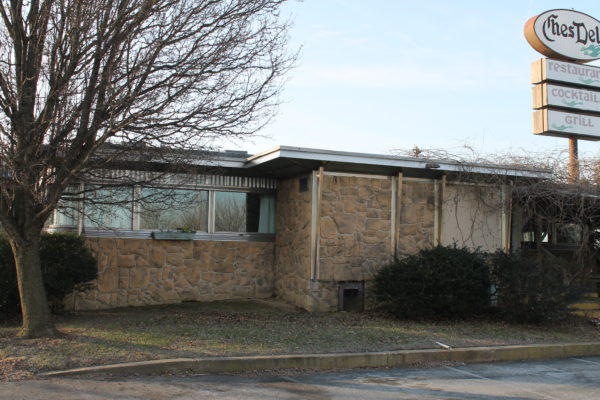
ChesDel Restaurant 2017 photo by Glenn Wells
Potato City Motor Inn, a 1949 Streamline Moderne structure featured in Rick Sebak’s “Pennsylvania Diners and Other Roadside Restaurants,” was demolished.
Water Slide World in Lake George, NY, a family run water park, did not open due to the death of his owner, who was the only person holding the necessary certifications. His widow originally planned to reopen, but soon enough its parcel was advertised as “12 Prime Commercial Acres for Re-Development.”
In New Jersey, the Egg Platter Diner in Paterson (Master) and the Circus Drive-In in Wall were both demolished.
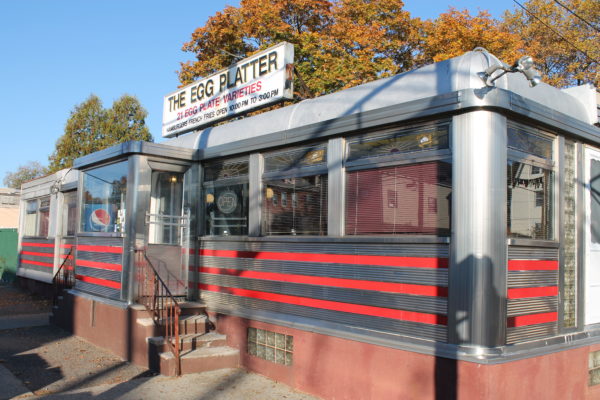
Egg Platter Diner 2016 photo by Glenn Wells
Bowl O Mat in Beverly, MA, a candlepin bowling center, closed and its contents were sold – right down to the hardwood lanes.
Rising property values forced out more diners in the New York City area, including the Shalimar Diner in Rego Park and the Flagship Diner in Queens. Goodfellas Diner in Queens closed after a fire last June, and while the DeRaffele diner is still there, it’s boarded up.
Yankee Diner in Charlton, MA is “Permanently Closed” according to Google, but at least while this vintage Worcester Lunch Car remains in place, there’s hope someone will reopen it.
The moral of this story: Get out and visit, patronize, and photograph vintage places while they are still around. Everything ends.
-
September 18, 2016
Get ready for “Open road tolling”
Roadside
UPDATE: On my most recent Florida car rental, from Hertz, the rental car did not have a transponder with the ON / OFF switch and instead used PlatePass to track tolls. When I tried to register the car with Toll By Plate as described below, I was told I could not. PlatePass caps your charge at “only” $24.75 – for a single $1.50 toll out of a one week rental. If you think you’re avoiding pitfalls by using Hertz – the traditional “# 1” car rental company – think again.
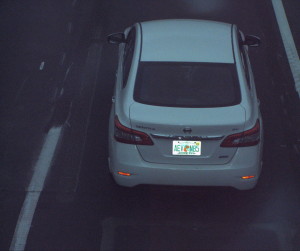
Photo of a rental car taken from a Florida overhead toll gantry with the license number clearly visible. The owner of the car (you or the rental company) later receives a bill, unless you arrange to pay the bill online.
Say goodbye to the toll booth. Say hello to open road tolling.
In Florida, it’s already here. Massachusetts will convert the Massachusetts Turnpike on October 28, 2016. And Ohio may be next.
Toll roads, of course, have been around for decades, and so too has the familiar toll booth, with a person inside who collects your money and gives you change. This basic arrangement remained unchanged until the 1990s, when electronic tolling systems were introduced, initially to relieve congestion on some of the busiest toll roads and bridges in the Northeast. Electronic tolling enables motorists to drive through the toll lanes without stopping, so long as they have a toll account and a transponder affixed to their windshield.
E-Z Pass is the largest system of this type, encompassing 38 agencies across 16 states, concentrated in the Northeast where most of the toll roads and bridges are located. Three Southeastern states have their own electronic toll collection systems, all incompatible with E-Z Pass: South Carolina (Palmetto Pass), Georgia (Peach Pass), and Florida (Sunpass).
Initially, electronic tolling used existing conventional toll lanes. As its popularity grew, especially in congested metropolitan areas, it became more common to see only one or two cash lanes, with the rest being electronic only. There was also grumbling from motorists about needing to slow down to 5 or 10 miles per hour (in a lane where formerly they would need to stop.) Because the slower speed was for the safety of the toll workers, not any technical requirement, some plazas were redesigned to allow electronic toll customers to drive at faster speeds.
This evolved into “open road tolling” where motorists stay on the highway mainline and need not slow down at all. The toll plaza on the New Hampshire Turnpike and the Woodbury plaza on the New York Thruway were rebuilt to take advantage of this, relieving long-standing traffic bottlenecks in the process. E-Z Pass customers stay to the left, maintaining 65 MPH speed, while cash customers stay to the right and stop at traditional toll booths. The tolling electronics are placed in overhead gantries, along with a system that photographs license plates, originally intended to catch scofflaws driving through without paying.
So that brings us to the present day and the latest toll road trend – the completely cashless open road tolling system where there are no toll booths at all and no option for paying a cash toll on the spot. Cars without a toll transponder receive a bill in the mail, sent to the registered owner of the car whose license plate was photographed (which tends to be slightly higher than an electronically collected toll.)
All electronic tolling certainly has a number of advantages, especially in congested areas. There’s no slowing down for the toll booth, no weaving to get into the proper toll lane (cash or electronic), and no fumbling for change. Everybody wins, right?
That may be true if you are driving your own car. But with a rental car, things get more complicated and potentially much more expensive.
On two recent Florida trips, my rental car came with its own SunPass, with an ON / OFF switch. Once you turn it ON and drive through an electronic toll barrier, you are agreeing to the rental company’s terms and conditions for using it. But read the rental contract very carefully – some charge an extra $4 a day for the entire length of the rental regardless of how much the SunPass is used. Thus, for a two week rental, a single $1 toll could cost you $56!
Therefore, if your rental car has a toll transponder with an ON / OFF switch, make certain it is turned OFF and leave it OFF for the entire period you have the car. (And check the wording on the switch very carefully – on my rental car, ON was down and OFF was up – backwards from a conventional light switch.)
But if you do nothing else and drive on roads using Toll By Plate, your outcome may be even worse. The signs may boast “We bill you with Toll By Plate” but remember those bills will go to the registered owner of the car, which is the rental company, not you. Expect a bill from the rental company with a substantial service charge tacked on – after all, the rental company expects you to use their transponder for $4 a day.
The answer is, you must pay your own tolls yourself and leave the rental company out of it. Fortunately, there are two ways you can do this:
1. Use your own transponder. If you don’t already have one, you can get one through any of the agencies issuing them – you need not be a resident of that state. (And remember South Carolina, Georgia, and Florida are not E-Z Pass states, so you will need to get a SunPass when visiting Florida, for example.)
2. Establish your own Toll-By-Plate account. We used this technique successfully on two Florida trips. Once you reach your hotel or some other place where you can safely go online, enter the license plate number from your rental car into your account with the dates of your rental. Most toll roads offer you a grace period, so you can backdate the starting date even if you have already incurred a toll. You will probably need to fund this account by means of a credit card, but this will enable you to pay your own tolls yourself, at the Toll-By-Plate rate, and leave the rental company out of it.
Looking ahead, it’s clear that open road tolling is here to stay. But because people can no longer “opt out” by paying a cash toll (unless they avoid the toll road completely, which often is not practical) a couple of changes are in order:
1. A national toll system where any transponder is universally accepted by all toll roads and bridges. A good step in this direction would for South Carolina, Georgia, and Florida to abandon their own systems and become part of E-Z Pass.
2. Consumer protections for rental cars. Because rental car customers can no longer avoid the high prices connected to the rental company’s transponder by simply going through a cash toll lane (and the Toll By Plate option is not made clear, either by the toll road or the rental company) it ought to be illegal for rental companies to reap huge profits off this. Customers ought to be able to use the transponder in their rental car for the cost of the tolls incurred alone, plus a reasonable service charge.
-
February 5, 2014
Diner openings for 2014
Diners
As 2014 begins, several vintage diners have recently reopened under new management, representing an interesting cross-section of diner styles, manufacturers, and degrees of preservation. We haven’t visited any of these diners yet under their present ownership, so we can’t offer any opinions on food or service. If you visit any of these diners, please let us know about your experiences.
Empire Diner, 210 10th Avenue, New York, NY
New York City’s Empire Diner has to be one of the most interesting diner preservation stories of all time. A 1940s Fodero diner sited in the Chelsea neighborhood, it received a partial façade makeover in the 1950s, masking the diner’s original roofline. But a more extensive renovation in 1976 received much more attention, including a cover story in New York magazine.
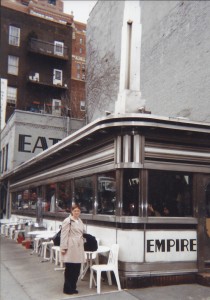
- Empire Diner (Fodero)
1999 photo by Glenn Wells
The red bands on the 1950s upper façade were repainted black and white (greatly improving the diner’s appearance, in my view), EAT was painted on the wall of an adjacent building in lettering matching that on the diner, and a skyscraper model was installed on the roof corner. The inside was modified in ways that ordinarily would make a diner purist cringe – the ceiling was painted black, track lights were added, and the table tops were overlaid with black Plexiglass. Nonetheless, the diner was a hit with the public and well-received within the diner enthusiast community as well, as evidenced by the fact that renowned diner artist John Baeder did a painting of the renovated Empire.
All was well until 2010 when things turned ugly, to say the least. Proprietor Renate Gonzalez was evicted and the diner was leased to a new operator. A fight ensued over the name Empire Diner, resulting in the new operator using the name Highliner Diner. The skyscraper model on the roof went missing. The interior was renovated, including the addition of a communal table. But the Highliner didn’t have all that long a life, closing at the end of 2012.
Now reopened under “celebrity chef” Amanda Frietag, the Empire has received another round of renovations. The ceiling is now white, probably a more appropriate color for a diner ceiling than black. There’s new booths and stools with backs, and it looks like the counter is shorter than it once was. But the Fodero winged clock is still there, and plans are to resume 24 hour operation once again.
Salem Diner, 70 1/2 Loring Avenue, Salem, Massachusetts
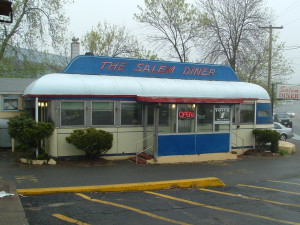
- Salem Diner (Sterling)
2006 photo by Glenn Wells
The Salem Diner is one of only two Sterling Streamliners still operating (the Modern Diner in Pawtucket, RI is the other one.) Recently acquired by Salem State University, the diner is operated by Chartwells, its food service operator. A similar arrangement exists at the Savannah College of Art and Design, where two diners – the Streamliner (Worcester) and Bobbie’s Diner (Mountain View) – are operated by the college’s food service operator.
Regular diner hours are Monday through Saturday from 6 a.m. to 3 p.m. and 8 p.m. to 11 p.m., and Sunday from 7 a.m. to 2 p.m. and 8 p.m. to 11 p.m. Those 8 to 11 nighttime hours seem geared toward students needing a late night snack.
Izzy’s Diner and Pizza (formerly Miss Adams Diner), 53 Park Street, Adams, MA
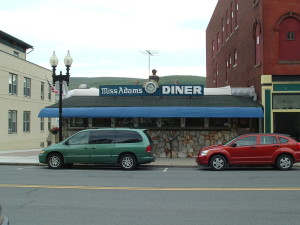
- Miss Adams Diner (Worcester),
2009 photo by Glenn Wells
The Miss Adams Diner, Worcester Lunch Car number 821, was delivered to Adams in 1949, replacing an older diner (still in use as Claudette’s 1921 Diner in Boylston, MA.) The diner received much favorable attention in the 1990s under the ownership of Barry and Nancy Garton (who today operate Brew Ha Ha in North Adams), but after they left, ownership of the diner was assumed by Boston restaurateur Jae Chung who leased the diner to a long succession of tenants, none of whom seemed to last very long. Then in 2005 – wrongly surmising the building was the problem – Chung undertook a “remodeling” which consisted of covering the original Worcester Lunch Car woodwork with shiny metal and stapling records to the ceiling, giving the place an artificial “retro 1950s” look. (One might say that with a 1949 Worcester Lunch Car they already had the real thing.)
By 2010 Chung had lost ownership of the diner and Steepleview Realty leased it to Philomene and Ric Belair, who ultimately were unable to come to terms to purchase the diner. Today, Izzy’s Diner and Pizza operates out of the old Miss Adams, run by Rick “Izzy” Solomon and Annmarie Belmonte. It’s the second time behind that marble counter for Belmonte – she was the last person to operate the Miss Adams under Chung’s ownership. And if a pizza joint isn’t your idea of the best use of a diner, take heart in the fact that meatloaf and lumberjack breakfast sandwiches are among the best sellers. They are even open for dinner, rare for a diner in New England!
Parkway Diner, 1696 Williston Road, South Burlington, Vermont
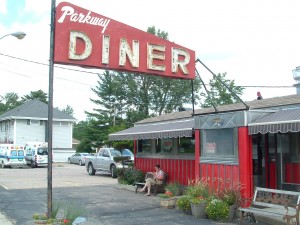
- Parkway Diner (Worcester)
2012 photo by Glenn Wells
Due to a lease issue, this diner dropped out of the orbit of northern Vermont diner mogul William Maglaris (who had renamed it the Arcadia Diner.) It’s the Parkway Diner again, now operated by Corey Gottfried. This diner highly impressed me on my one visit in 2012 – even with the Arcadia name. Manufactured near the end of the Worcester Lunch Car Company’s long run (# 839), this diner sports stainless steel trim on the outside – an attempt to keep up with the New Jersey manufacturers – but inside, there’s still varnished wood trim and cooking behind the counter.
The Diner (formerly Sullivan’s Diner), 59 Old Ithaca Road, Horseheads, NY
The Irish name Sullivan fit well with the original green tile and trim of this 1940s Silk City diner. So, what happens when the diner is taken over by a Yankees fan – one who wants to put his mark on the place? Sullivan green gives way to Yankees blue, and original Silk City tile work on the counter and floor is lost. The two views below show how Sullivan’s looked in 2008. Now, click here to see some photos of how it looks now.
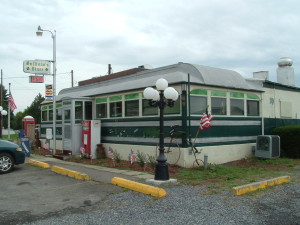
- Sullivan’s Diner (Silk City),
2008 photo by Glenn Wells
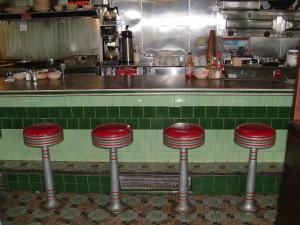
- Sullivan’s Diner counter
2008 photo by Glenn Wells
Katz Club Diner, 1975 Lee Road, Cleveland Heights, Ohio
If one vintage diner is good, then two have to be better, right? You might want to consider the history of this diner pair in Cleveland Heights before answering. Originally the Zephyr Diner (O’Mahony) from Berwick, Pennsylvania and the Terminal Diner (Mountain View) from Atlantic City, both diners received a meticulous restoration at Steve Harwin’s Diversified Diners before opening in Cleveland Heights as Dottie’s Diner and the Sweet City Diner. By the time of my visit in 2006, ownership had changed and they were Chris’ Diner and Jimmy’s Diner. Next it was Clyde’s Bistro, and the interior of the Mountain View was gutted. Now the Katz Club Diner, the O’Mahony has received some renovations that take it farther away from its original O’Mahony look, covering the original terrazzo floor with tile and replacing the booths with tables. Here’s two views of the O’Mahony from 2006 (when it was Chris’ Diner). Now, click here for a news article with a picture of how the interior looks now.
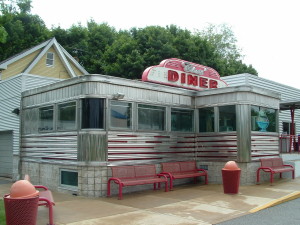
- Chris’ Diner (O’Mahony)
2006 photo by Glenn Wells
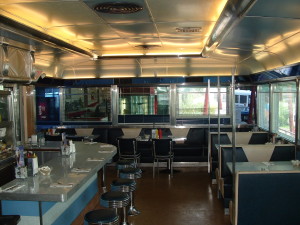
- Chris’ Diner interior
2006 photo by Glenn Wells
More news on the blog
